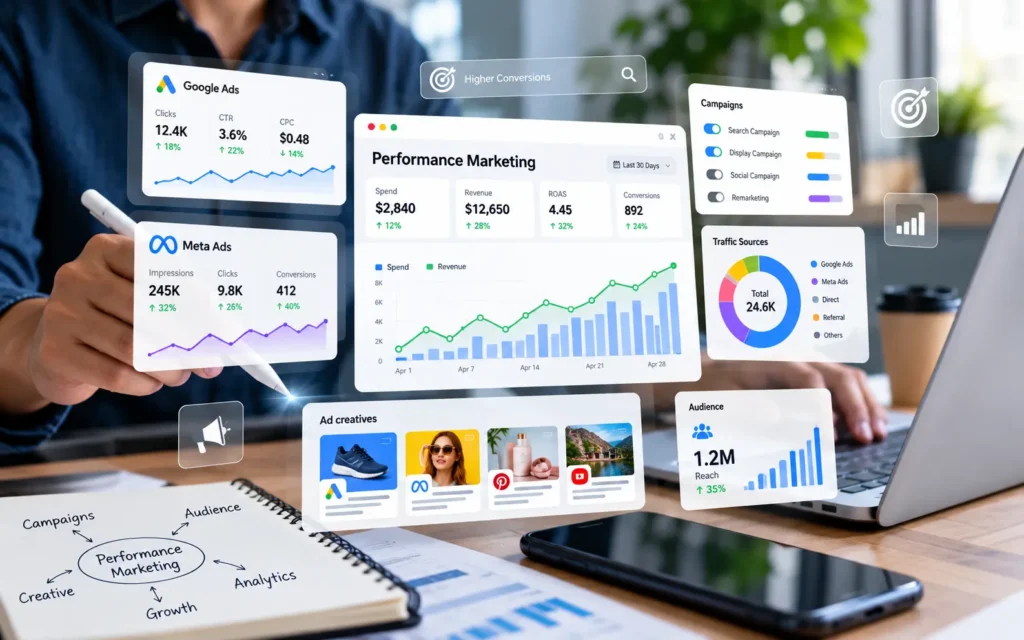
Imagine only paying for marketing when it actually works: when someone clicks, signs up, or buys. That is the promise of performance marketing, and it is why it has become one of the most popular approaches for businesses that want growth they can measure and defend. This guide explains what performance marketing is, how it differs from traditional advertising, the main channels involved, and how to build a campaign that delivers real results.
What Is Performance Marketing?
Performance marketing is a form of digital advertising where businesses pay based on specific actions, such as a click, a lead, or a completed sale, rather than paying a flat fee just to have an ad seen. Instead of guessing whether a campaign worked, performance marketing ties spend directly to outcomes, so every rupee or dollar can be traced back to a result.
This model covers a wide range of channels, including paid search, paid social, affiliate programs, and programmatic display, all connected by one idea: marketing should be accountable, trackable, and optimized continuously based on real data.
How Performance Marketing Differs From Traditional Advertising
Traditional advertising, like a billboard or a magazine ad, is usually paid for upfront based on exposure, regardless of how many people actually take action. Performance marketing flips that model. Budget is tied to measurable results, campaigns can be adjusted in real time, and underperforming ads can be paused or reworked before they waste further spend. This makes performance marketing especially attractive for businesses that need to justify every marketing rupee with a clear return.
The Main Channels of Performance Marketing
Performance marketing is not a single channel. It is a strategy applied across several channels, each with its own strengths.
1. Paid Search (PPC)
Paid search puts your business at the top of search results for keywords your customers are already typing in. Because it targets active intent, someone searching for exactly what you offer, paid search often delivers some of the highest conversion rates in performance marketing.
2. Paid Social
Platforms like Instagram, Facebook, and LinkedIn allow highly specific targeting based on interests, behavior, job title, and more. Paid social is especially effective for building awareness and retargeting people who have already shown interest in your brand.
3. Affiliate Marketing
In an affiliate model, partners promote your product and only get paid when they generate a sale or a lead. This shifts much of the risk away from your business, since you are paying for outcomes rather than exposure.
4. Programmatic Display
Programmatic advertising uses automated bidding to place your display ads across a wide network of websites and apps, targeting the right audience at the right moment without manual placement.
5. Video Advertising
Platforms like YouTube allow performance focused video campaigns where you pay based on views, clicks, or conversions rather than a flat placement fee, making video a measurable channel rather than just a branding exercise.
Key Metrics Every Performance Marketer Should Track
Because performance marketing is built on data, tracking the right metrics is essential. The core ones to watch include:
- CPC (Cost Per Click). How much you pay, on average, every time someone clicks your ad.
- CTR (Click Through Rate). The percentage of people who see your ad and click on it, a strong signal of how relevant your message is.
- Conversion Rate. The percentage of clicks that turn into a lead, sign up, or sale.
- CPA (Cost Per Acquisition). How much it costs you to acquire one paying customer or qualified lead.
- ROAS (Return on Ad Spend). How much revenue you generate for every rupee or dollar spent on advertising.
Benefits of Performance Marketing
- Clear return on investment. Every campaign can be measured against actual business outcomes, not just impressions.
- Budget control. You can start small, test what works, and scale spend only on what is already proving successful.
- Faster feedback. Results start showing within days, allowing quick adjustments instead of waiting months to know if something worked.
- Lower risk. Since spend is tied to results, wasted budget on underperforming campaigns can be identified and cut quickly.
How to Build a Performance Marketing Campaign
- Set a specific, measurable goal. Define exactly what a successful outcome looks like, whether that is a lead, a purchase, or a sign up.
- Choose the right channel for that goal. High intent goals often favor paid search, while awareness focused goals may fit better on paid social.
- Build tracking before you launch. Set up conversion tracking so every result can be tied back to the campaign that produced it.
- Test creative and targeting. Run multiple ad variations to see which message, audience, and offer perform best.
- Review performance regularly and reallocate budget. Shift spend toward what is working and pause what is not, on an ongoing basis rather than only at the end of a campaign.
Common Performance Marketing Mistakes to Avoid
- Launching without proper tracking. Without conversion tracking in place, it is impossible to know which campaigns are actually working.
- Focusing only on clicks, not conversions. A high click through rate means little if those clicks never turn into leads or sales.
- Changing campaigns too often. Constantly editing live campaigns can restart the learning phase and slow down performance.
- Ignoring the landing page. Even a well targeted ad will underperform if it sends traffic to a slow or confusing landing page.
- Chasing vanity metrics. Impressions and reach look good in a report, but they do not pay the bills. Revenue and qualified leads do.
How Thrive Tech Studio Can Help
Running performance marketing well takes more than boosting a post or launching a Google Ads campaign. It takes clear tracking, constant testing, and a strategy built around the numbers that actually matter to your business. Our team at Thrive Tech Studio manages performance campaigns across search, social, and display, all built on top of the same brand and web experience we design, so your ad spend and your website work together instead of against each other. Take a look at our services to see how we approach paid growth.
If you are ready to turn your marketing budget into measurable results, get in touch with our team for a free consultation. We would love to help you build a performance marketing plan that actually pays off.